Tuesday, September 11, 2018

Beyond the Battlefords

It's no distance from Toon Town (thank you Cam Culham!) to the Battlefords (Fort B, B, and North B) and we headed out on Tuesday morning. We rolled into North Battleford at lunchtime expecting to visit Fort Battleford. The National Parks website said it would be open on September 4 and we organized our time to fit that statement. We showed up on site to find locked doors and a phone number to call for deliveries. Clearly not for us. I wasn't feeling my diplomatic best and gave "buddy" a bit of a hard time on the phone. He called me "young lady" several times not knowing I was about to reach through the phone and rip his throat out. Apparently NPC had not told Fort Battleford they were supposed to be open on the 4th and all the summer staff were gone. Buddy came to the door eventually, apologetic, but he was the maintenance man, not a ranger or interpreter.
Another carload of 6 people arrived on our heels to the same answer. I will be writing to NPC!

Luckily there is a Western Development Museum in North Battleford, one of 4 in the province. These museums are really well done and this one includes an outdoor village of 30 buildings, an elevator, and a train station. The contents aren't very different from the WDM in Saskatoon which is all indoors but the village setting gave context to the artifacts in a different way. Thirteen of the buildings are original and others were purpose built. So much in these museums was part of our normal childhood. It is amusing to see familiar items deemed to be historic but Saskatchewan is very young. For example, the school room is pretty much exactly what my elementary school looked like. NOT the hair curling contraption! Good grief!!!


It was windy which seems to be a theme.
On the way to Moose Jaw the next morning we stopped in Unity to look for a probably non-existent photo studio where our friend Don Rowlatt worked as a teenager. Mention Saskatchewan to any group of people and I can guarantee that someone has lived here at some point. At least in a western group. We stopped in a café and asked the server who asked her boss and a table of local women. Guess what? One of the women remembered Don's family and the location of the studio, now a realty office. So we took a picture of course. Keep in mind, this was 60 years ago - what were the chances? Apparently excellent! And the three women had a lovely time reminiscing about the old days.


Sunday, September 9, 2018

Grain Elevators

Where to start on this topic without going backwards and sideways? Years of talk about the vanishing elevators had us not expecting to see very many so we've been pleasantly surprised to find that they still exist, sort of. The new ones are enormous and concrete but there are enough of the old wooden ones that they've melded into our brains as a real part of the Saskatchewan landscape. There are a very few still in use but most are empty, some in grave disrepair and the lucky ones turned into museums.


It took me a while to get the concept of the elevators, explanations seemed to stop with the first step, the producer delivery, but this is my version of what happens. Please feel free to chirp in with corrections...

Yes, that Dog River


1. The producer arrives with grain on a cart, drives up the ramp and into the elevator, onto a weigh scale built into the floor. There is a grate in the scale cover, with the metal vanes typically slanted so a horse sees it as a solid floor and doesn't spook. The cart either has a tilt mechanism or a shovel and the grain is emptied into the pit below. The grain is analyzed for moisture content and debris which affects the price. The empty cart is reweighed and the difference plus the other factors determine what the producer receives. Some elevators were modified to accommodate larger trucks (by cutting out some rafters!) but the system was the same. 
2. A conveyor belt in the pit carries the grain sideways to a scoop/bucket system, the elevator, that carried the grain up and up to one of several bins. An elevator handled more than one product and a wheel was used to direct the product into the appropriate bin-in-the-sky. 


3. A train pulls up to take delivery and this is the part that was only sketchily described when I said was was still confused. It is so basic to local people they couldn't understand my blindspot so I'm winging it here. From the appropriate bin above, grain, peas, lentils, whatever comes down a chute onto another scale to be weighed. Then another conveyor belt and scoop/elevator rig carries the product back up high enough to go out the side of the elevator and down into the train car. And that, I think, is that.

Other interesting tidbits: 
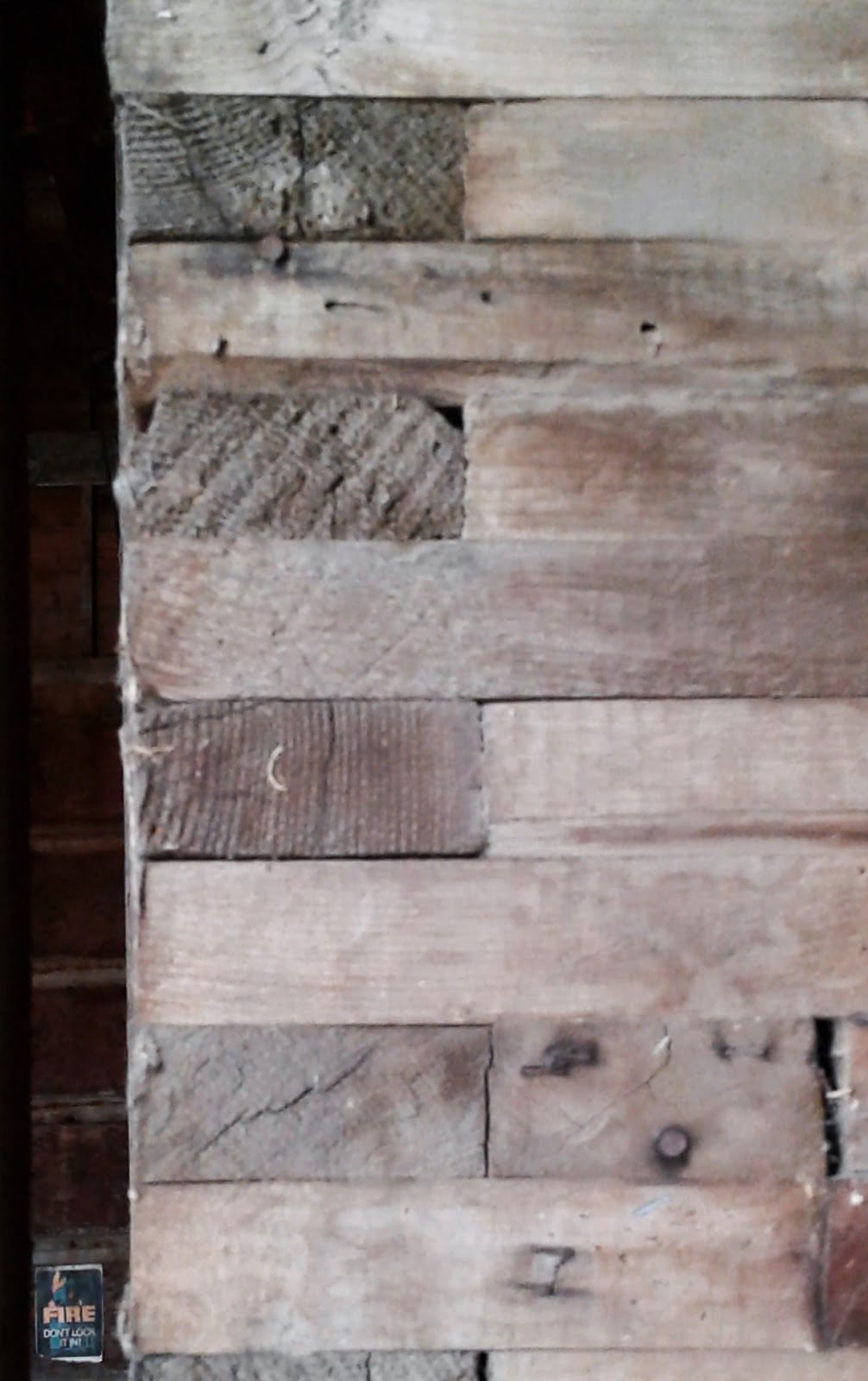
  • The elevators are built of 2x4s on the flat, stacked like a log house. Otherwise the weight of the grain would push the sides out. That's a lot of wood and all of Saskatchewan's plentiful forests are way in the north. The major structural elements are enormous so maybe came from BC.

  • Grain is very dusty and the dust is explosive. More than a few of the elevators burned down. Apparently once an elevator fire starts it is impossible to stop so the effort goes into containment.
  • There used to be an elevator every 8 miles along the train tracks, the distance a horse could haul a loaded cart in a day. Wiki says there were 6000 elevators back in the 1930s.


Way Off the Beaten Track

There are about 250,000 kms of roads in Saskatchewan, not all of them wonderful and a lot of them gravel! Everyone seems to own a truck.
When she heard we were going to Saskatchewan, one of our neighbours gave us a 2010-ish Readers' Digest Atlas of Canada. Every double page has a flip-out with a smattering of what someone thought was an interesting spot in that area. I spent hours with that book and we've spent hours chasing down some of the oddities. Our GPS didn't recognize them but Google Maps did! Jim and Betsy were less excited about these weird and wonderfuls but humoured  me and we had lots of laughs in the search.

Crooked Trees according to Wikipedia, The trees, prominent in Saskatchewan folklore, are dramatically different from the un-twisted aspens just across the road. Explanations have been offered which include various paranormal factors. However, cuttings from these trees, propagated in Manitoba, exhibit the same pattern of twisted growth, suggesting that the cause is rooted in genetics, possibly the result of a mutation.The trees' unusual appearance was noticed in the 1940s and has attracted the attention of tourists for decades. Jim's reaction? "Aren't all trees crooked?" We were on our way from Saskatoon to North Battleford and we added about 2 hours to the trip by going via Hafford/Alticane to see the trees. For all the hype, the grove is small and yes, decidedly odd. But it had an outhouse! 


Great Wall of Saskatchewan, near Smiley. No, you can't see it from space. The wall was a 30 year project, finished in 1991, self supporting without mortar, and about a half kilometer long, built from rocks taken out of a farmer's fields. What isn't mentioned in the references is how gorgeous the rocks are. These are not our jagged gray BC rocks, rather beautiful pieces of pink granite with some stunning golden lichen growing on sections. That's a locust on the windshield!


The Great Sand Hills is a 1900 square kilometer desert/dune area about 25 km on more gravel roads, from Sceptre. The visitor centre was closed because now it's after Labour Day, but there was a detailed map and directions posted on the door. Betsy's master's thesis was about the ecology of salt water sand dunes so she was adsorbed in looking for marram grass or other familiar botanicals.

The car has taken a bit of a beating on the back roads and there is dust in every crevice. Jim hasn't figured out how to get the locust remains out of the grill though in North Battleford the car wash had an "insect removal" wand. We have a following of wasps wherever we go, feeding on the grill carnage. 


And many miles to go....

I forgot to mention that going off the beaten track has so many bonus surprises! A herd of bison, I assume meat herd because they looked well fed and tended, and an abandoned Ukrainian church.

Hafford


Saturday, September 8, 2018

Saskatoon and so much more

from the top of the Duck Lake visitor centre/museum

Saskatoon is nice; pretty nice. There is a fantastic river walk/park with sculptures and gardens, and an obvious effort to have flowers and public art. The city feels quite small but apparently is about the size of Victoria. Also small of course. We stayed at the Park Town hotel on Don Rowlatt's advice and enjoyed the location, the restaurant, and the pub. We were on the top floor with a fab view of the river and the bridge across to the university. Day one we went to the Museum of Western Development, drove through U Sask, and visited the Diefenbaker Centre on campus. We continue to be impressed by the energy and effort that goes into preserving the history of the province and the smallest pieces of it. There are 4 MWDs, the Saskatoon one is all indoor, massive, and incredibly interesting.
Day two we went to Wanuskewin First Nations heritage park, minutes north of city centre. It's being redeveloped and the plans are impressive. We went on a guided walk and were part of a tipi raising ceremony. Then, with time left on the table we went north to Prince Albert, PA as it's known. We had cancelled PA and Lloydminster because time was short so were glad to add one back even if it was a hit and run. Cruising in to town on a wrong road I spied an onion dome and we chased it down to take pics. While we were pressing our noses up to the door a car pulled up and women got out WITH KEYS! And they let us in for a look because we were so obviously interested and harmless. Wow, what a place. The women were bringing supplies in for the Friday perogy supper which, if it was next Friday I would push to go back for; but it was yesterday. Again, the commitment to community and tradition was uplifting. inspirational. We also drove by Diefenbaker's house which had closed for the day by then,
But the day wasn't over yet.
On the way back south we pulled into Duck Lake I don't remember why. Some interesting looking buildings maybe, including a stage coach. There was a crop we couldn't identify so even though it was getting late we pulled into the visitor centre for, a multi-storied tower, "five minutes" which has become a famous refrain. 45 minutes later and further inspired by the volunteers who run the local museums we are back on the road.
Seriously people, there are more "sparkplugs" in Saskatchewan than anywhere else in the universe. We need to look around and pick up a cause/project because, speaking for myself, I am not pulling my weight. No one talks about the work involved, just the pleasure.
THEN we went to Taverna for dinner, back in Saskatoon and met Luigi. Slick as you can imagine, hugely entertaining, and we let him select a memorable meal for us.

some of the beautiful bead work we've been encountering; this at Duck Lake
Holy Trinity Ukrainian in PA


Saskatoon mural

Mr Medicare, Tommy Douglas!

this was an interesting idea with no traction

First Nations beauty

The rellies

Friday, September 7, 2018

Perogies

Sister Bets decided to drop in for a week-long visit and we were to meet her in Saskatoon.  We left Veregin with Canora (CAnadian NAtional RAilroad)in mind and perogies. There was the Ukranian greeter at the entrance to town but perogies? No. we met a sort-of local who was also surprised that the visitor centre/museum wasn't open and who sent us to Terry's to find our about perogies, but Terry's wasn't open either. Canora is a two Chinese restaurants town but that wasn't on my radar so we had an Aussie Bite and kept going. A while later, passing through Watson, not only was there a roadside Santa Claus but a cafe advertising home-made perogies. A U-turn, which I have a lot of practice at, and bums in seats for the real deal. Our still-with-the-accent hostess was delightful but was dead keen to move to Victoria especially when she asked about mosquitoes and we said no. We stuffed ourselves with borscht, perogies, and sausage, yum, and moved on.
We passed through Humboldt and I was comforted to see that it is a decent sized town with, I hope, enough heart and resources to recover from the devastating accident that killed so many of their young men in 2018. I was imagining one of the many very small towns that couldn't possibly absorb that level of tragedy.
On to Saskatoon and met Bets at the Irish pub attached to our hotel, the Park Town. Mum would have been proud! Later we went to the Hudson for food and then to the absolutely most fantastic fireworks display any of us have ever seen. I was too busy looking to take pics. Sorry!


Tuesday, September 4, 2018

A quick stop in Veregin

What can I say about the Doukobors. What I remember from the 60s/70s is the Sons of Freedom in BC, savagely opposed to having to send their children to school and conform to provincial laws. They marched naked, held hunger strikes, burned buildings, and fought vehemently to keep their autonomy.
In essence the Doukobors were pacifist vegetarians, in search of their version of utopia. After years of heavy persecution, Leo Tolstoy, the Quakers, and others put together enough money to get 7500 Doukobors our of Russia and to Canada via Halifax.
Veregin SK is named for the leader of the group that emigrated from Russia to Canada. Several years later Canada changed the rules and insisted on some adherence to national standards in order to keep the assigned land. But in BC it was different, so off they went, many of them, to the Grandforks and New Denver areas; until the rules changed again which is the angst that I remember. They were right to fear schools and integration because their world has disappeared into the realm of museums as a result of the exposure to the mainstream lifestyle that was less restricted and so mush easier.
By now Veregin is the National Doukobor Heritage Village, and that's it. A passionate, peaceful, hardworking and not without its problems society has disappeared into our modern mash.
tin trim to Peter 'Lordly' Veregin's house

apparently a typical bedroom with the hanging cradle

a 100 year-old furcloak

the most beautiful lace and other handwork

Unplanned in Esterhazy

August 31, we were on a bit of a long haul stretch from Estevan to Veregin to the National Doukobor Heritage Village and planning to spend the night in nearby Canora (named by putting together the 1st 2 letters of each word of, Canadian Northern Railway).
Passing through Esterhazy I noticed two road side signs: potash interpretive centre and flour mill. A quick aside: it seems that every town no matter how small has a grain elevator, a museum, a park, and signs at the outskirts that let you know about them. I had completely forgotten about the potash industry; largest producer of potash in the world! You can get lost in the farming details of 75% of Canada's mustard, best red lentils in the world (1.6 billion hectares), wheat, barley , oats, and canola, and many, many, many head of beef. And oil wells of course.
So I said, let's stop for 5 minutes. Two hours later we got back on the road. The museum alone was delightful with a wealth of human and household artifacts. Then the young caretaker said the potash interpretive building was definitely worthwhile, so again I said, 5 minutes. She opened up and 1 minute in, I said to Jim, "change of plan, we'll go to Yorkton tonight and Veregin tomorrow". Absolutely, says he. So we listened and learned and were awed and impressed. There is a city 3000 ft below Esterhazy with miles and miles of tunnels and roads, a mechanic shop, rest areas, and a 40 kph speed limit. Potash is a very big deal in Saskatchewan and the world.
And THEN the youngster-in-charge took us into the flour mill, the only wooden flour mill in left in Saskatchewan, which started gristing in 1907. AND it has an elevator attached so we got the whole story from the horse drawn cart of grain driven onto the scales, the bucket elevator that unloaded the grain, the gristing process,and the final product. Magic!
It pays to read the signs in front of you because Esterhazy was not on our radar at all and it was a fabulous stop  for us.
the only wooden flour mill left in Saskatchewan

wedding dress in the museum with stunning beading

the driller blades in a potash mine

one of 3 head shafts near Esterhazy

on the road!